
Explanation
Learning Objectives in this module are
・Understanding the definition and significance of direct training
・Understanding the prerequisites for safely starting direct training
・Understanding when direct training should be discontinued
Explanation
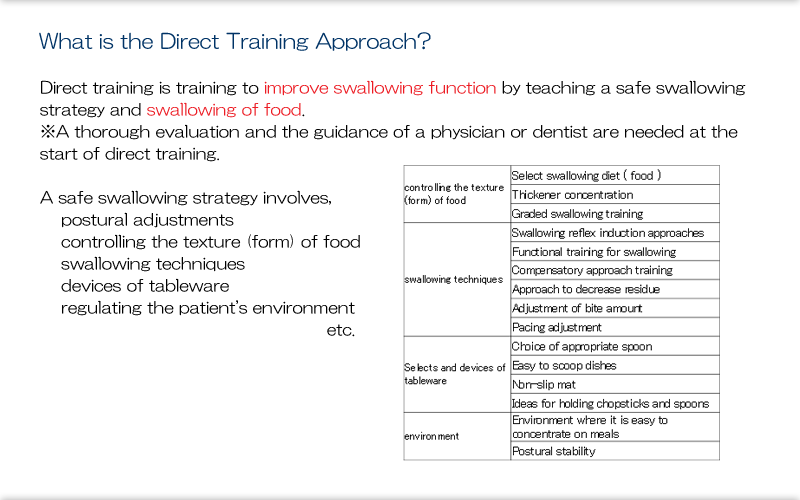
Direct training is training to improve swallowing function by teaching a safe swallowing strategy and swallowing of food. A thorough evaluation and the guidance of a physician or dentist are needed at the start of direct training. A safe swallowing strategy involves postural adjustment, controlling the texture (form) of food, swallowing techniques, determining which eating utensils to use, and regulating the patient's environment.
Explanation
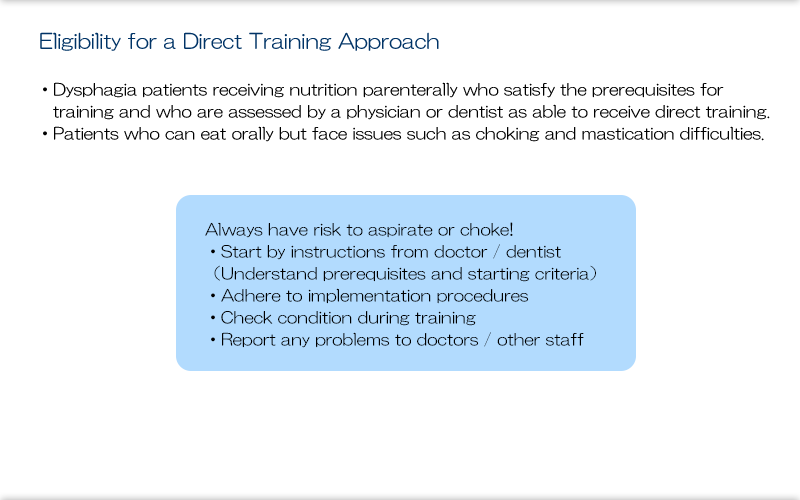
Direct training has the potential to cause severe problems such as aspiration and suffocation because it involves improving swallowing function with the use of food. Crucially, direct training is provided after determining whether prerequisites are satisfied, with a knowledge of the following eligibility criteria for this training approach:
1) Dysphagia patients receiving nutrition parenterally who satisfy the prerequisites for training (see next slide) and who are assessed by a physician or dentist as able to receive direct training.
2) Patients who can eat orally but face issues such as choking and mastication difficulties.
Explanation
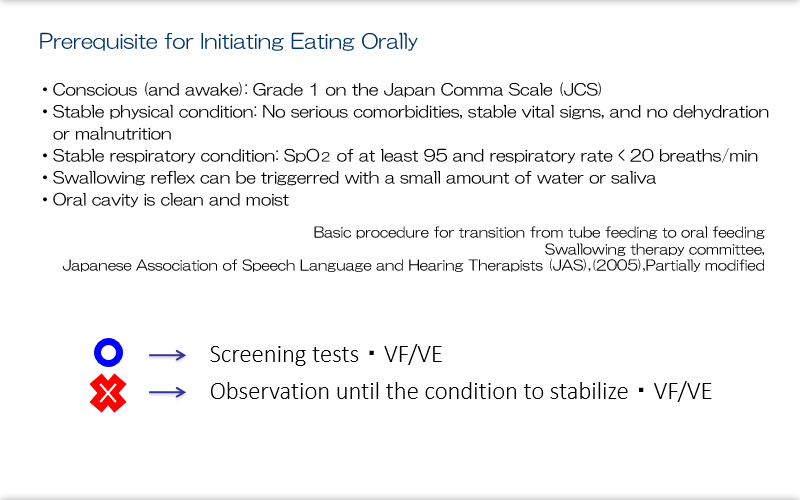
There are several prerequisites and criteria,
・Conscious (and awake): Grade 1 on the Japan Comma Scale (JCS)
・Stable physical condition: No serious comorbidities, stable vital signs, and no dehydration or malnutrition
・Stable respiratory condition: SpO2 of at least 95 and respiratory rate < 20 breaths/min
・Swallowing reflex can be triggerred with a small amount of water or saliva
・Oral cavity is clean and moist
Patients satisfying these prerequisites then undergo further screening examinations for swallowing function and a detailed evaluation to determine their eligibility. Patients not satisfying these prerequisites may be re-evaluated once their condition has stabilized.
Explanation
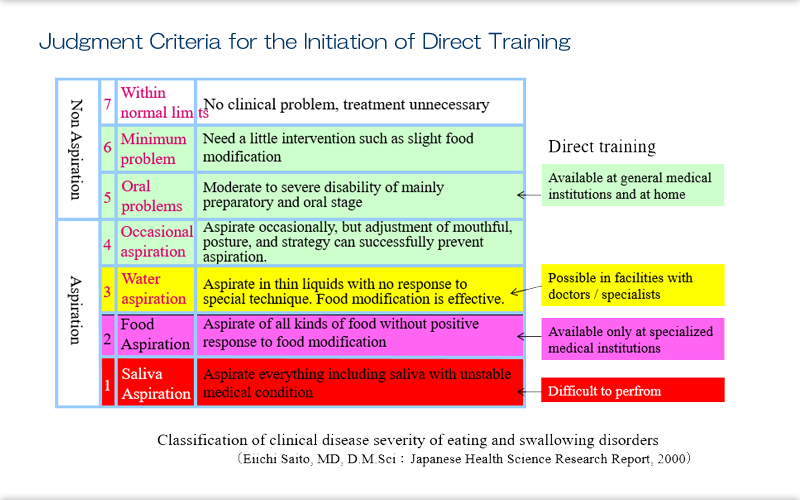
The results of an evaluation of swallowing function determines whether direct training can be started. The evaluation to start direct training can be made: at home or at a general medical center when patients have mild difficulties, problems with the oral cavity, and occasional aspiration; at a medical center with expertise in dysphagia when patients have water aspiration; or at a medical center with somewhat limited expertise in dysphagia when patients have food aspiration. However, because factors such as the patient's cognitive function and general condition can affect the safety of direct training, the physician makes a comprehensive judgment based on a range of information.
Explanation
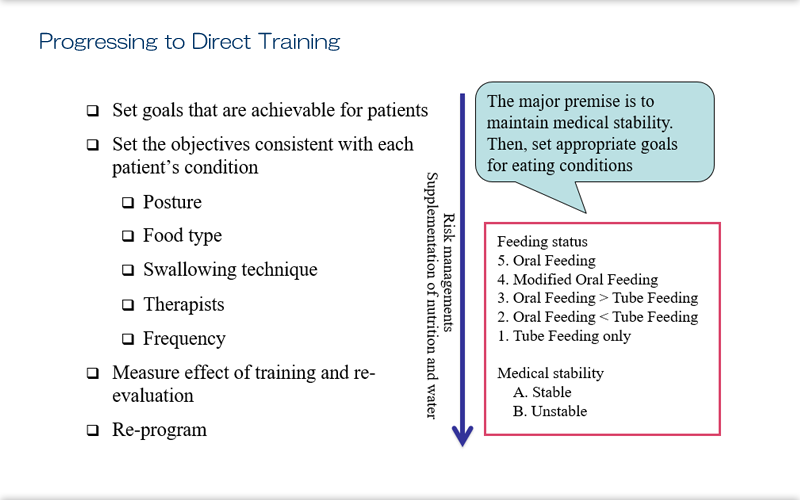
First, based on assessment results, we set goals that are achievable for patients. It's not always possible to set the goal as eating orally 100% of the time. We must prioritize medical safety and set the objectives consistent with each patient's condition. We then need to determine the appropriate posture, food type, and swallowing technique to be used, drawing up a training program suitable to meet the goals that includes who provides the training and the extent and frequency of the training. Training is then provided, and the effect of training is determined through observation and re-evaluation. The training program is adjusted to improve function as patients progress through training.
Explanation
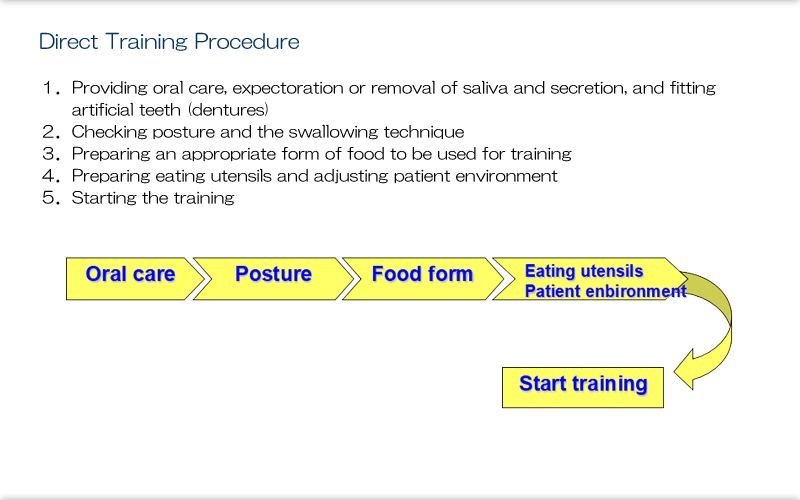
Training is started after the following preparation for preventing aspiration and pneumonia.
1. Providing oral care, expectoration or removal of saliva and secretion, and fitting artificial teeth (dentures)
2. Checking posture and the swallowing technique
3. Preparing an appropriate food type to be used for training
4. Preparing eating utensils and adjusting patient environment
5. Starting the training
Explanation
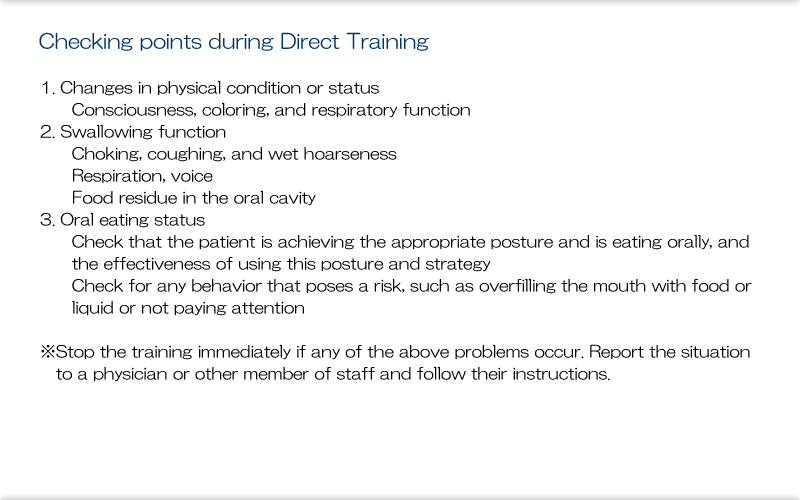
Risk management is important during direct training. Proceed with the training while observing the patient's physical condition for any changes, swallowing function, and ability to manage eating orally. Monitor the following:
1.Changes in physical condition or status
- Consciousness, coloring, and respiratory function
2.Swallowing function
- Choking, coughing, and wet hoarseness
- Respiration, voice
- Food residue in the oral cavity
3.Oral eating status
- Check that the patient is achieving the appropriate posture and is eating orally, and the effectiveness of using this posture and strategy
- Check for any behavior that poses a risk, such as overfilling the mouth with food or liquid or not paying attention
Stop the training immediately if any of the above problems occur. Report the situation to a physician or other member of staff and follow their instructions.
Explanation
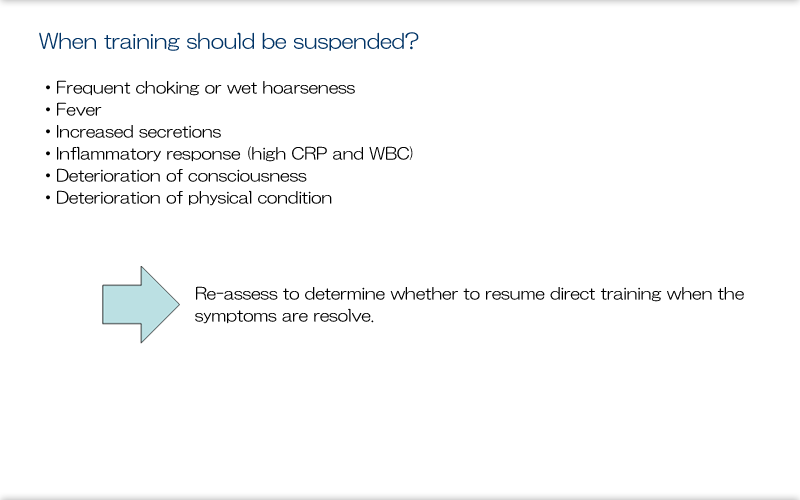
If any of the following occur after starting the training, consult a physician and suspend the training:
- Frequent choking or wet hoarseness
- Fever
- Increased secretions
- Inflammatory response (high CRP and WBC)
- Deterioration of consciousness
- Deterioration of physical condition
When the above resolve, re-assess to determine whether to resume direct training.
Explanation
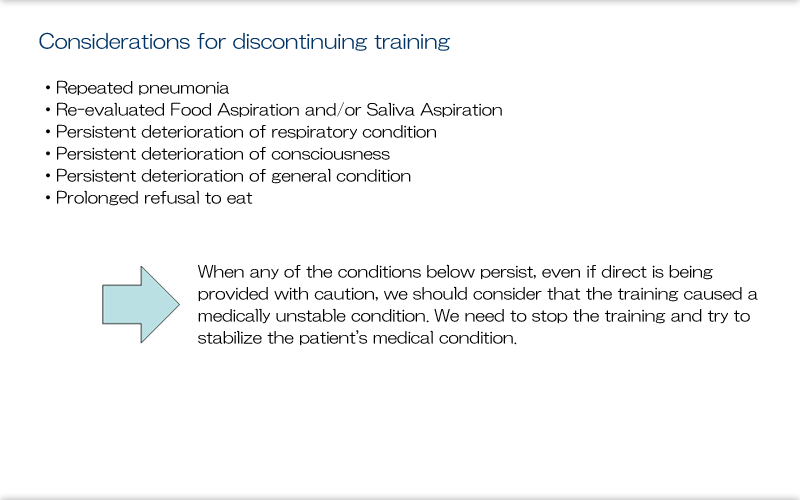
When any of the conditions below persist, even if direct is being provided with caution, we should consider that the training caused a medically unstable condition. We need to stop the training and try to stabilize the patient's medical condition. Discontinuation is considered through discussion with a physician and members of the swallowing team.
- Repeated pneumonia
- Reevaluated Food Aspiration and/or Saliva Aspiration
- Persistent deterioration of respiratory condition
- Persistent deterioration of consciousness
- Persistent deterioration of general condition
- Prolonged refusal to eat

References
- Japanese Association of Speech-Language-Therapists. Swallowing committee: Basic procedure to progress from tube feeding to oral intake, JASLT,2005.
- Eiichi Saitoh: 2009 Heath and Labor Sciences Research Grant Report「Treatment and Intervention of Dysphagia」Comprehensive studies report, 1999, 1-18.